
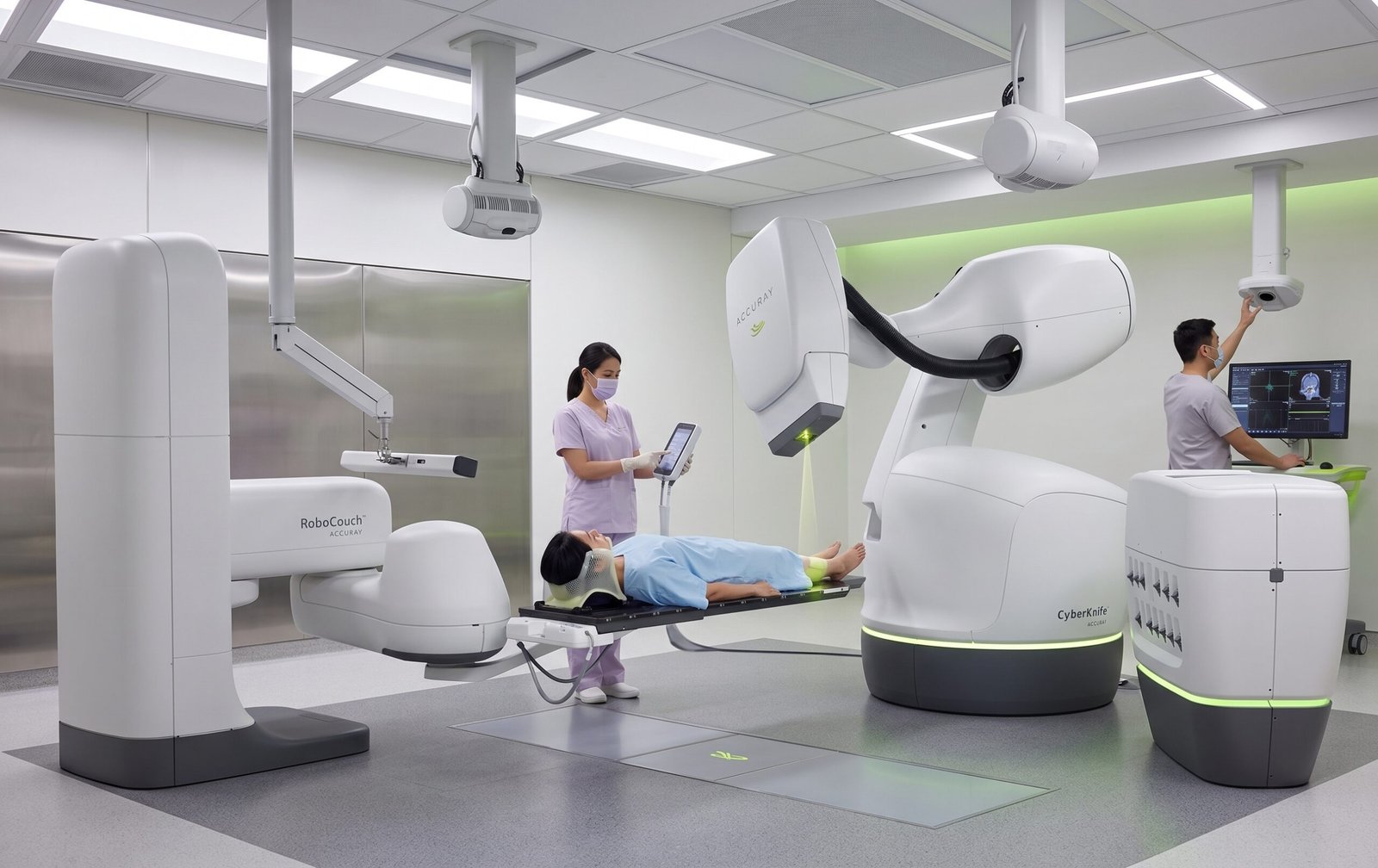
Precision oncology technology platform
PRECISION TECHNOLOGY ECOSYSTEM

It Is Not About Having More Machines,
but Having More Precise Choices.

From seeing the disease clearly to choosing the right technology for treatment.

From precision PET/MR and multimodal image fusion to multi-platform radiotherapy with CyberKnife, TomoTherapy, TrueBeam, Halcyon and Ethos, the goal is to build an integrated precision oncology technology system that can be selected and combined according to lesion location, number, size, motion and treatment objectives.

Patients Do Not Need to Choose the Machine First. First understand the disease clearly, then design the plan; after that, select the technology pathway that best addresses the actual clinical problem.
MULTI-MODALITY · ONE CLINICAL PURPOSE The Same Cancer Diagnosis May Still Require Completely Different Technologies.

When lesion characteristics and treatment goals differ, imaging, planning methods, radiotherapy platforms and motion-management strategies may also need to change.

SEE

Precision ImagingPET/MR · PET/CT · 3.0T MRI · 4D-CT

PLAN

Intelligent PlanningMultimodal Fusion · Target Delineation · Dose Planning

TREAT

Multi-Platform TreatmentCyberKnife · TomoTherapy · TrueBeam · Halcyon

ADAPT

Adaptive PrecisionEthos · HyperSight · HyperArc · Motion Management
CORE TECHNOLOGY PLATFORM

An Integrated System, Not a Single Machine.

This opening section provides a quick technology map. The following sections will focus on clinically differentiated technologies, real-world application experience and translation into practice.

IMAGINGPET/MRMetabolic + anatomical imaging
ROBOTIC SRS / SBRTCyberKnife M6Robotic precision & tracking
HELICAL RTTomoTherapyComplex & extended targets
VERSATILE RTTrueBeamIMRT · VMAT · SRS · SBRT
IMAGE-GUIDED RTHalcyonEfficient image-guided treatment
ADAPTIVE RTEthosAI-assisted adaptive treatment
One diagnosis does not mean one technology. Even with the same cancer diagnosis, different lesion locations, numbers, motion patterns and treatment goals may require different technology pathways.
ADAPTIVE & INTELLIGENT RADIOTHERAPY

Tumors Change. The Body Changes.
Treatment Technology Can Adapt Too.

Precision radiotherapy is moving beyond a “plan once, deliver repeatedly” model toward faster image verification, online adaptation and dynamic tracking. The focus here is not how many machines are available, but how these technologies can actually change the treatment process.

CHINA FIRST · CLINICAL DEPLOYMENT · 2025

HyperSight

Halcyon v4.0 Advanced Image Guidance

In September 2025, the hospital completed its Halcyon v4.0 upgrade and implemented HyperSight clinically in China for the first time. Faster, higher-quality treatment imaging helps doctors verify the patient’s anatomy and target position more clearly before each treatment.

15s → 6sCBCT SCAN TIME
HigherIMAGE QUALITY
AdaptiveDECISION SUPPORT
DAILY ADAPTATION

Ethos Adaptive Radiotherapy

Organ position, filling status and tumor anatomy can vary from day to day. Online adaptive technology can reassess and optimize the treatment plan using the imaging acquired that day.

Today's
Image
Today's
Anatomy
Re-
Optimize
Today's
Treatment
CLINICAL EXPERIENCE

HyperArc

The hospital has accumulated substantial experience in precision radiotherapy for brain tumors and multiple brain metastases. For complex intracranial multi-target cases, HyperArc uses a single isocenter, non-coplanar geometry and highly automated stereotactic radiotherapy workflows to improve treatment efficiency.

12,000+ Annual Radiotherapy Cases
Clinical Treatment Volume
Multiple Brain Metastases Single-Isocenter Non-Coplanar Automated SRS
MOTION MANAGEMENT Precision Is Not Only Knowing Where the Tumor Is, but Also Where It Moves During Treatment.

For lung, liver and other lesions that move with breathing, different imaging and motion-management techniques can be combined for positioning and treatment.

4D-CT Respiratory Gating Dynamic Tracking IGRT
INTERVENTIONAL & LOCAL PRECISION TECHNOLOGIES

Precision Treatment
Does Not Always Begin Outside the Body.

For selected solid tumors, treatment may use vascular intervention, local drug delivery, ablation or radionuclide therapy to target the tumor or its blood supply more directly. The goal is not to “use every technique,” but to determine which local treatment is appropriate for the current clinical objective.

DIRECTED · LOCAL · IMAGE-GUIDED Bring Treatment Closer to the Lesion — Not Every Therapy Has to Begin with Systemic Circulation. Interventional techniques can use catheters to reach the target blood supply, while local treatments are selected according to the lesion’s location and characteristics for a more direct approach.
INTERVENTIONAL CHEMOTHERAPY

Interventional Chemotherapy

A vascular catheter is advanced into the tumor-related blood supply to deliver medication locally according to the disease status and treatment objective. Suitability depends on factors such as cancer type, vascular anatomy, tumor burden and the patient’s overall condition.

Local Drug Delivery
TRANSARTERIAL INTERVENTION

Tumor Vascular Intervention

Based on the tumor’s blood-supply characteristics, vascular intervention may be used for embolization or other local treatments, with the goal of targeting tumor perfusion and local disease.

Targeting Tumor Blood Supply
TUMOR ABLATION

Tumor Ablation

For selected localized or oligometastatic lesions, different ablation techniques may be evaluated according to the lesion’s location and surrounding structures as part of a local-control strategy.

Microwave · Cryoablation · IRE / NanoKnife*
INTERNAL RADIOTHERAPY · NUCLEAR MEDICINE

Y-90 Radioembolization

Y-90–loaded microspheres are delivered through an interventional approach into the blood supply of the target tumor, providing selective internal radiation within the lesion. This pathway combines imaging assessment, vascular intervention and nuclear medicine treatment.

Imaging + Interventional + Nuclear Medicine
Y-90 SELECTIVE INTERNAL RADIATION
The First Question Is Not “Can It Be Done?” but:
01 · TARGET Where Is the Lesion? Location, number and relationship to critical organs.
02 · PURPOSE What Is the Goal of Local Treatment? Tumor control, symptom relief or management of a high-risk lesion.
03 · COMBINATION Does It Need to Be Combined with Systemic Treatment? Local therapy is often one component of the overall treatment pathway.
* Specific interventional, ablation and radionuclide treatments are determined according to the hospital’s currently available clinical services and the individual patient assessment. A technology name does not mean that it is suitable for every patient.